
Are magic truffles legal?

Yes, since 2019, for the simple reason that they are taxed.
Look, here: Judgment of the Royal Netherlands Court CONFIRMED in 2022:
Magic truffles are a legal stimulant, while mushrooms forbidden remain.(see below)
„yes, but in germany it's different!“
Not as long as Germany is part of the EU and does not explicitly ban truffles.
When an EU country sets a tax rate for a product, this process is called legalization. Every time truffles are purchased, the seller pays taxes to the country to which they are delivered. In other words: A customer from Germany pays money to the German state for magic truffles. A customer in Italy pays taxes to the Italian state for his truffles. So that can the purchase is not illegal.
But... Psilocybin is illegal, isn't it?
Only magic truffles are legal
Magic truffles are not psilocybin. This is not nitpicking, but follows the same logic as „A human is not DMT“ or „A cactus is not mescaline“.
DMT, mescaline and psilocybin have all been banned by the United Nations since 1971. Then as now, this means that trade in the pure substance is illegal. But and here's the thing: this does not apply to organisms that contain these substances, unless they are explicit forbidden!
Just like cannabis, at least in the past.
Coffee shops only work in Holland because they charge taxes on coffee. That's right, coffee! The concept of a coffeeshop is that hemp friends meet there, chat about their love of cannabis and drink coffee, which the coffeeshop then taxes and pays the tax to the state. The Dutch state is not allowed to levy taxes on cannabis because it is not legalized, i.e. it has no tax class. Not like truffles, which have one.
Is it slowly becoming clearer? The whole thing came like this...
Mushrooms were banned. Truffles were legalized.
Magic mushrooms were sold freely until the 1990s, in the Netherlands, Germany, Switzerland, the Czech Republic... in fact everywhere in Europe.
This has led to problems with naïve tourists. Mushrooms and alcohol in the pedestrian zone of a large city are a very bad mix.
More importantly, however, at the end of the 1990s, more and more people around the world realized that mushrooms could be extremely good for mental health. Antidepressant, harmless, non-addictive and easy to grow - so not very profitable economically. As a result, magic mushrooms were gradually banned in Europe by explicitly adding to the narcotics laws: „Mushrooms containing psilocybin are also forbidden!“
There was never any mention of truffles, anywhere. No country mentions truffles in its legal texts.
Until suddenly, out of the blue, the Netherlands declared truffles a luxury food in 2019. They were given a tax class, thus becoming a product on the European market and no cock crowed about it. NOBODY has objected to this or even tried to include truffles in their BtmG.
1. magic truffles are safe.
Truffles have been on the market for over 20 years.
When mushrooms were banned in the Netherlands from one day to the next in 2007, huge producers were suddenly left empty-handed.
With no income but plenty of free time, they set about taking their government to court. Understandably, their business had been destroyed.
Even before the dispute over the destroyed mushroom market went to court, the government conjured a solution out of a hat: truffles! „Just sell magic truffles“ - the former mushroom traders were told. „They're not banned and won't be banned. There's your business!“
And so it came to pass that truffles were mass-produced and of course not banned, but even legalized.
2. microdosing is becoming increasingly popular
The microdosing hype really took off in 2018. The internet was unstoppable and this was also reflected in the sales of growers and retailers. Great, but back then they only paid 9% tax on truffles as if they were regular foodstuffs. Without an assigned tax rate, this was simply decided by the traders.
September 13, 2019
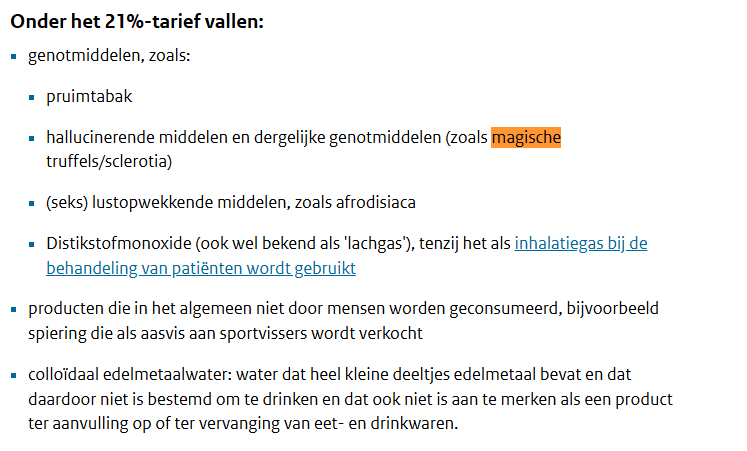
This already changed in 2019: „Magic truffles are now a luxury food. The tax rate of 21% applies, but mushrooms remain prohibited!“
EU internal market
The Dutch tax authorities (Koninklijke Belastingdienst Nederland) officially classified magic truffles as a luxury food in 2019, which represents an important step in their legal position.
Luxury foods are defined as functional foods that are consumed for their pleasurable effects and not for their nutritional value. This classification places magic truffles in a different tax category and they are no longer considered a product of the gray market.
This decision was supported by a Judgment of the Royal Netherlands Court CONFIRMED in 2022: Truffles are indeed a legal luxury food, while mushrooms remain banned.
The European Union functions as a single market, which means that any product manufactured and marketed within the EU borders is equally available in all member states. The exclusion of customers based on their location, the so-called Geo-blocking, is unlawful. Geo-blocking refers to the practice of denying access to goods, services or content based on a user's geographic location. This practice is widespread in the e-commerce industry and can result in customers being unable to purchase items or access certain websites due to their location. Geo-blocking is seen as a form of discrimination and is therefore subject to regulation in many countries.
In the European Union, for example, geo-blocking is generally prohibited under the rules of the Digital Single Market, which are designed to ensure that customers have access to goods and services on the internet regardless of their location. Companies that engage in geo-blocking face penalties and fines. It is therefore important that they inform themselves about the regulations in their country.
Can I get into trouble if I order magic truffles online?
No.
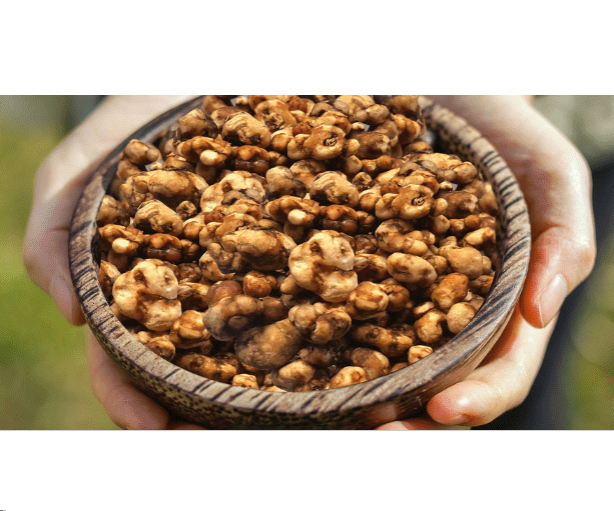
Some customs offices may not be up to date with the differences between magic mushrooms and magic truffles.
So if you receive a letter saying „You have ordered mushrooms and that is forbidden!“ The answer „I didn't, if these are mushrooms, send me a photo where you can see mushrooms!“ is enough!“
Of course we will help you to ensure that everything goes smoothly. So please write us an email immediately if your parcel is held up.
info@provithor.com
Are magic mushrooms also legal?
Mushrooms are not marketable, i.e. illegal for trade.
Only private use is permitted.
In other words: grow kits are okay, ordering mushrooms online is illegal.
Ordering mushrooms online is actually quite dangerous, and not just for legal reasons. Illegal dealers have no quality standards whatsoever.
With regard to the legality of magic mushrooms, it is important to note that the UN decision of '71 did not concern truffles or mushrooms containing psilocybin.
In one case from 1978, the Supreme Court of Florida concluded that psilocybin is covered by the law, but not psilocybin-containing mushrooms or other life forms that contain psilocybin. This decision placed both magic mushrooms and truffles in a legal gray area where possession of these mushrooms was neither condemned nor punished.
That's why mushrooms were still sold freely in Europe until the 2000s. Both in the Netherlands and in Germany, you could get them just like that at the kiosk.
Taxes
A legal product means that the trader is forced to pay taxes to the country.
For an EU country to rightly ban a product from the market, it must provide scientific evidence that the product is harmful to consumers' health. Our products, especially the Magic Truffles, are healthy, non-addictive and do not harm health in any way.
Magic truffles have been legalized - this means that the Dutch tax authorities have classified magic truffles as a „stimulant“, which is taxed at full VAT because of its psychedelic effect (unlike food to fill the stomach, which is taxed at a lower VAT rate). This was done on 13ten No mainstream media has mentioned this and so a lot of disinformation is being spread here and there about the legality without taking into account that hundreds of scientific studies conducted since 2015 have proven the powerful health benefits of Magic Truffles - banning a non-addictive, non-harmful but healthy product seems impossible on reasonable reflection.
However, it is important to understand that what seems clear and simple has a pitfall, namely Dutch marketing, which promotes the idea of „exclusivity“ in the Netherlands for its own profit.